Lee Alexander McQueen was born in Lewisham a small area of South East London into a working-class family. His father is a cab driver, and his mother is a science teacher, and he has five other siblings. At a young age, Lee had recognized his homosexuality and was teased and humiliated by other schoolmates. At the age of 16, he dropped out of school, attended a tailoring course, and had multiple work experience in costume design. He also attended Rosetta Art Centre, and later, the principal of the school- Yvonne Humble, wrote him a reference letter to Central St Martins. He graduated with a master’s degree in 1992.
DEBUT- JACK THE RIPPER STALKS HIS VICTIMS
McQueen’s first collection, “Jack the Ripper stalks his victims,” inspired by the serial killer Jack the Ripper, had drawn a lot of attention from fashion aspirants and editors, including Isabella Blow- a famous fashion influencer based in London. She bought his entire collection and later became McQueen’s best friend and an advocate for his profession.
● Fact: McQueen sewed locks of hair to the garments to refer to the practice of prostitutes selling their hair in the Victorian Era.
THE HIGHLAND RAPE
However, McQueen had not been exposed to the public until his iconic “bumster pants” were born and featured in his second collection, “The Highland Rape.” His inspiration came from the tragic event in Scotland when English people took over Scotland, damaged the islands, and left a lot of misery. Also, Lee’s father is originally Scottish, and to the best of my belief, this had heavily influenced him; thus, “The Highland Rape” was born. It was not only a collection, but it was also a story that made up a part of McQueen, and he expressed his pain through his marvellous art.
GIVENCHY HEAD DESIGNER
Only four years after his graduation, McQueen gained numerous achievements, included winning British Designer of the year in 1997, and later offered to work in Givenchy as Head Designer.
Alexander’s Debut collection at Givenchy 1997- Photo by Vogue
Fact: In 1997, McQueen replaced John Galliano at Givenchy, and John Galliano joined Dior. They both release their debut collection at their new couture houses at the same time and were constantly put into comparison
AN UNFORGETTABLE SHOW
Source -Designer’s Atelier
Once again, Lee surprised the public by dressing an amputee model as the vedette in his S/S1 999 Show. The spotlight is on the ordained wooden boots, which grasped the audience’s absolute attention, and McQueen is one of the first designers that started the body-positivity movement by dressing such an unexpected model. You’re mistaken if you think it’s the only twist in his show. Shalom Harlow appeared in a strapless dress, standing on a rotating platform and paint-sprayed by two robotic arms, is the moment that the audience truly remembers years after the show. It turned out to be one of the most memorable shows in his career, and perhaps in the fashion world.
Image source by Another Mag
WORKING ON HIS TRUE ART
Despite his success, while working in Givenchy, Alexander claimed that he felt restrained and the only way he could unleash his full creativity is to break the whole concept and image of Givenchy, but clearly, they would not let him do that. Subsequently, his dream came true since Gucci had bought a controlling interest from McQueen’s brand (51%) and let him be the Creative Director. In order words, Gucci took care of the business and finance prospect, and the creative part is totally up to Lee. This event was a precursor to many extravagant and mind-blowing collections, and one followed another.
VOSS Asylum- Photo by Vogue UK
VOSS Asylum- Photo by Vogue UK
THE BEGINNING OF GLOOMY DAYS
As mentioned above, Isabelle Blow is one of the most influential women in Alexander’s life. Not only did she help him shine and rise in the very first days of his career, but she was also a life-long friend of his. However, her mental disease seemed to ruin her life and the friendship between McQueen and her. Isabella Blow committed suicide in 2007, which had left McQueen in sorrow. At the same time, he was also tested positive for HIV and severe drug addiction.
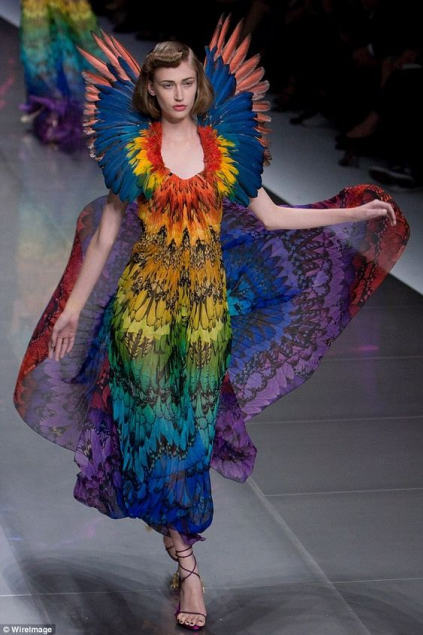
With attention-grabbing headwears and feather decoration- Blow’s signature, the 2008 collection “La Dame Bleue” was a dedication from McQueen and Phillip Tracey- another close friend Blow to the eccentric aristocrat.
Source by Wireimage
He later released Plato’s Atlantis collection from the idea of humans turning into sea creatures in the apocalyptic future. In this collection, McQueen brought to the world another innovative fashion item- armadillo boots, which people usually called McQueen’s heels. The event is also the first live-stream fashion show.
Armadillo boots- The Museum of Savage Beauty
Fact: The live-stream site crashed after Lady Gaga tweeted about it. Lady Gaga is also a fan of McQueen’s gowns (which is not a surprise).
HIS LEGACY
In 2010, McQueen’s mother died of kidney failure. No sooner than his beloved mother’s death, he committed suicide in his own house and brought the finale to a fashion legend. In contrast to his daunting runway stages, he only left a note saying sorry and told people to take care of his dogs before closing his life stage forever.
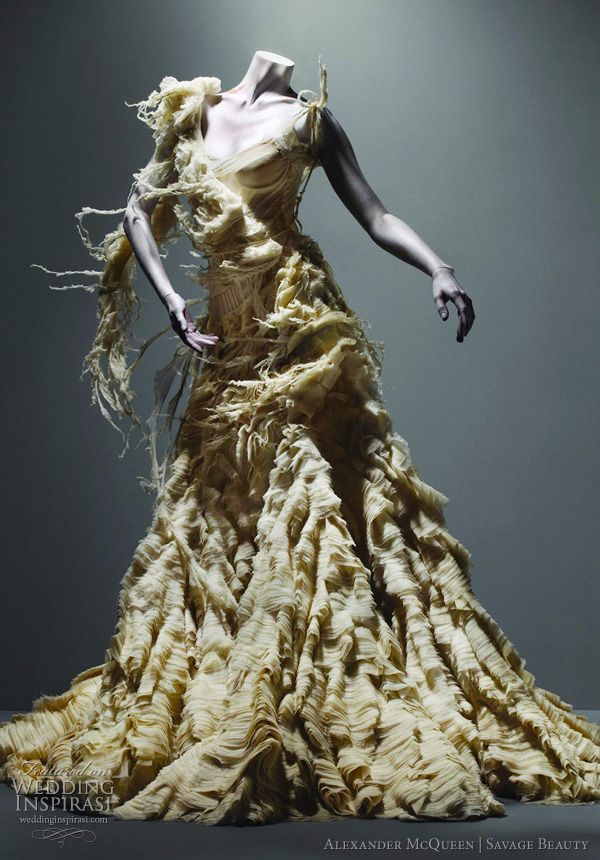
A year after his death, NYC’s Metropolitan Museum of Art opened a “Savage Beauty” exhibition to showcase Lee’s astonishing work. Thousands of fashion lovers from all over the world came to New York to visit this exhibition, and it later became the most visited exhibition of that museum.
Image source photoframd
McQueen is one of the reasons I wanted to pursue fashion, especially costume design. I am extremely influenced not only by his work but by his life and what he had been through, also by the way that he combined two significantly different factors: brutality and femininity, death and life, into one breath-taking form of beauty. McQueen’s life is strange and iconic. His curse is his blessing, and his blessing is also his curse.
Today, I’m going to introduce you to Max Feldman. He was one of the panelists from LCV Fashion Laboratory and does some really amazing work in fashion. I interviewed Max over the phone on March 21st to find out his story in the fashion industry and share it with all of you.
This is going to be a longer read as we were on the phone for quite a while. However, I promise it is a good one. Max has a real passion for what he does and has some really interesting experience and perspectives to share throughout his career story. Plus, there’s a funny story at the end. Enjoy!
LinkedIn profile photo for Max Feldman
AR: Thank you for agreeing to be interviewed.
M: Yeah. Of course, of course. I’m happy to help. It’s a topic I like so anytime I get a chance to talk about it, it makes me happy. Well in a sense.
AR: Yeah. With the blog, we want to interview people across the industry because, oftentimes, when people think of fashion, the main thing they think of is the big-name designer that’s kind of a celebrity in their own right. But there’s so much more to it than just that and as fashion grows to keep up with the changes in the world, there are more and more positions available and more and more ways to get into the industry. So, I want to highlight what different people do and how they got into the industry and all that.
M: Oh yeah. That’s really great. It’s a topic that I think is really, really important and I bring it up often in my conversations with my students because of your exact point that you made. I think when people get into the industry and fantasize, romanticize about it, it’s like “Oh, I want to be a fashion designer.” But that is one small, single-digit percentage of what makes the industry go around.
AR: Yeah. It’s what everyone sees so it’s what everyone wants, but that’s only a tiny bit. There’s so much more behind it that makes everything run.
M: Yeah, exactly.
AR: So, I want to know your story of how you got into fashion, what got you started, and what got you to where you are today.
M: Yeah. Okay. Let’s see. So, how did I get started? I mean, I started out in a completely different industry. When I left school, I was working in web design at the time.
AR: That is completely different.
M: Yeah. So, I was never trained as a designer in any way, but I had some technical skills that I developed in high school around building websites and using tools like Photoshop and Illustrator, so I had a good grounding. I did a multimedia degree in university with the intention of going into some kind of audio production or music or something like that. But, when I graduated from university in 2000 with my undergrad, there was a lot more opportunity in the web or audio/web crossover space. So, I focused my career there and I was able to really easily get a job building websites and doing some online animation work, like flash animation and stuff like that. So, I did that for a number of years. I moved to Vancouver and eventually I kind of found my way into the film industry doing digital graphics for film, and while I was working in the film industry, I had a boss, a production designer, who had a great idea of starting up a men’s underwear business. And, he had this idea of making really playful, colourful, fun, cheeky, predominantly men’s underwear, but we did men’s and women’s because there was nothing really like that on the market. Other than Joe Boxer, everything was, basically, Calvin Klein and stuff like that.
AR: Yeah, and a lot of men’s underwear is plain black or white or it’s themed with a character or something.
M: Yeah, and the reality was, he was also targeting a very particular market too. A lot of it was tongue in cheek, there was mostly imagery but a lot of it was kind of a play on male sexuality in a lot of cases, and just sexual puns and things like that. So, it was really playful and tongue in cheek and it was really colourful and really bold. The idea was since I was already doing work with him, he tasked me with developing some prints and creating some fun graphics for this underwear business and then launched it, really quickly. Pulled some funds together, launched the business. Essentially him and I started it and at first, I started off simply doing graphics because none of us had any idea how fashion worked. We didn’t know about fabrics, lead times, single-needle versus a serger. Nobody knew. We didn’t know anything, right? We didn’t know about how things were assembled or tech packs. It was like, we had an idea, we did the visual part, he was an excellent salesperson and marketer, I knew how to do the design work, like just surface design and that was it. We quickly built a team and then one of the things we didn’t really understand was the kind of roles we would need. We really focused on the front-end roles, we didn’t focus on the back-end roles, like product development and quality and all that stuff. We really relied on the factories that we worked with to own and manage that part of the business. But, what we were finding was that we needed to have some level of expertise there because we couldn’t just rely on the factories to just blanket make our projects, as long as they kind of look like this is fine because you need consistency. You needed to make sure things didn’t shrink, you needed to understand tolerance. There’s all this stuff that we couldn’t just leave with our factories, so I took on the responsibility to learn that as much as I could, and I spent a lot of time in factories. We started off in China and eventually, we moved our production to El Salvador and I spent, at one point, six months in El Salvador, practically living at the factory, just being immersed, hiring a team of people who finally hired some patternmakers and product developers and technical people. I learned all about cutting and patternmaking and assembly and quality.
AR: So, you really learned everything hands-on?
M: Yeah, and being hands-on, it allowed me to really start to understand at a deeper level. I mean, I learned only a small fraction of what I needed to know but at least I knew enough to be able to make fair decisions. And, what I recognized doing that, was that I really liked that part of the business more than I liked the graphics or the design side of the business. I quickly started to realize that all the design I had done and the fact that I had tailored my career in that direction was because it was one of those things that I could do and I had access to it and it was easy enough for me to get work in it but it was not something that I was really passionate about. It was almost like I had an opportunity to get in because I had the requisite skill to do it, but it was not what I actually wanted to be doing. I was young, I was making choices with the information that I had and once I had that realization, I was like “Oh. Actually, you know what. I like the business side more. I like the technical side more of this and I like the fashion industry itself. I liked the idea of taking an idea and making a physical good out of it and all the steps that you have to go through and the complexity and the nuance.” I really like that part of it and what I recognized is that I wanted to stay within the fashion industry and I also wanted to work more on the technical and the business sides of it. Whatever that looked like. That was the moment that I really pivoted my career. Working with that company, I did that for about two years and things didn’t work out. Once it ended, I decided that I was going to pursue work in fashion and that’s when I really wholeheartedly started approaching different organizations and trying to find a way that I could get into the industry properly and work for some more reputable, bigger companies and maybe start honing my skills there. So that was kind of like the birth of my career in a very long way. I started kind of working fully in fashion with that company. It was 2005 and then my first real job after that was at Lululemon in 2007. That job at Lululemon was, I like to call it, my real immersion within the fashion industry even though I’d already been working in it for two years. But working at the underwear company was really, I almost call it my education, it was like my undergraduate in…
AR: Kind of like the internship that we do during school?
M: Yeah. It was like a two-year internship full of all kinds of craziness. It was a wild ride but also an amazing, amazing experience.
AR: And then you moved on to Lululemon and what did you do there?
M: Yeah. When I started at Lululemon actually, it’s pretty funny, because I was pretty clear that Lululemon was one of the companies that I wanted to work for, and I felt there was a really strong values alignment. I was into yoga, I really felt that there was a strong alignment in their beliefs around positivity, around personal responsibility, around inspiring people and I wanted to be a part of that. I felt like as far as a business goes it really resonated with who I am and the mark that I wanted to leave and the impact that I wanted to have for both myself and those around me. The problem is that Lululemon didn’t want to hire me at first because I had only had a couple years of experience working at this weird little underwear company and I actually, in reality, I didn’t have formal training. They recognized this and said: “Well, also, we think you’re great, but we also don’t have a job for you.” So, I was missing some hard-technical skills and they also didn’t, at the time when I first started talking to them in 2006, they weren’t quite ready to bring somebody like myself on. So, I actually went, and I started working in their retail store. I was close to thirty, I was by far one of the oldest people in the group interview at that time, which was kind of an interesting experience. But I felt like I was in a position where I could do that for a brief period of time, six months to a year, with the idea that I could talk to the right people and eventually transition myself into the head office. So, I took a job at Oakridge Mall Lululemon, which was awesome, 2006 or seven, I can’t remember when, it was something like that, 2006 I think, and I was an educator. I worked, I think I worked full time at the time and I was pretty explicit when I started there because they do this whole thing where goal setting is a really big part of the culture and I believe it still is. At the time it was like, “Okay. What are your goals? Why are you here? What do you want to get out of this?” And I was like, “Look. This is what I want to do. I want to work for this company in this capacity. This is an access for me to do it and I want to be here. I want to learn how the company works. What better way to do it than to be on the front lines?” They thought that was great, they hired me and then about six weeks later I found myself in an interview for two different roles at head office, which was awesome. Again, I just met the right people. I had the right conversations because at that time head office staff were regularly working in the stores, that was a mandate of the business. So, I met somebody in design, somebody in raw materials, I met a bunch of different people and very quickly I had two offers for roles. Like I said, I think what happened was, once people spent some time with me and they understood, it was like “Okay. Well this guy, he may not have all the technical skills, he has a good foundation, he has a really good cultural alignment.” That was the thing that was big for them at the time was cultural fit. They really spent a lot of time making sure that you as an individual aligned with the culture and values of the business, and then your technical consideration was secondary which I really appreciate. I think it’s the right way to hire in general, but that’s a whole separate conversation.
AR: Yup. I agree though because you can teach technicality, but you can’t teach personality.
M: Yeah, that’s right, that’s right. Yeah. So very soon after that, I started working as a, I think my job was Trims and Notions Developer at Lululemon What that meant was I, basically, was responsible for the entire portfolio of all the trims that we dealt with. Anything that wasn’t fabric fell in my domain that was responsible for the supplier network, the development of the trims, the management of the trims within our supply chain and how they’re used, how they’re spec’d, working with the product developers and designers around systems for managing our trims and choosing colours and developing new designs. So, it was a pretty immersive job because nobody had done it in the past. Nobody was managing the trims in any kind of comprehensive way. It was basically like “Okay, I need a zipper. Okay, that one.” There was no standardization around coding them, which suppliers we used, how we purchased from suppliers. So, I came in and I built a system for it. There were only two people in raw materials, well three people in raw materials at that time at Lululemon. There was the woman that did all the fabrics, there was an assistant who is now faculty at Kwantlen, and there was myself, in 2007. Now the raw materials team is, I’m going to guess, upwards of eighty to one hundred people. It was, clearly, a different time. I did that for three years. I spent three years and it amazing. I got to travel extensively through Asia. I spent a lot of time in China because China and Taiwan were where a lot of our suppliers were based, and I got to do some really cool projects. I started just before the business went public, so I got to see Lululemon grow from a small company to quite a large company. I changed desks I don’t know how many times, to how many different new offices. And, at that time, in 2008, I decided that I wanted to further my education and do my MBA because I thought that would really kind of help me get ahead a little bit. Also, it would help me be better at my job because I never studied business and what I recognized I was doing was, I was no longer in a creative job. I was actually in a really, kind of strategic business role, which was ultimately what I was doing. I was building systems to make sure that that part for our business was effective, was efficient, it made sense and I really needed to know how business worked on a global scale to understand how I can just be better at my job and I can move on in my career. So, in 2009 while I was still doing that job, I started doing my MBA part-time at UBC and in 2010, based on that and my experience at Lululemon, I got a promotion. I moved up into a managerial role. My job was called Sourcing Manager, so I was responsible for something similar to what I was doing with trims but instead of trims, now I was working with all of our finished goods. Accessories supply chain, so that was yoga mat suppliers, our glove suppliers, hats, socks, headbands, electronics, anything that wasn’t a piece of clothing, that product fell under my umbrella. I took on that role and that was great because it was a more increased level of responsibility, now I was responsible for a certain amount of our revenue and ensuring that we had the right suppliers to deliver that particular product and I started actually managing people. I had one person that I was now responsible for. I had my analyst now, which was awesome. She was great, she really helped to do some of the more detailed work, I guess you could say, while I focused on a little bit more of the strategy. I did that for two years and that was an awesome time. From the time I was at Lululemon to the time I left, the business went from a hundred million to a billion dollars, it was pretty significant. It saw ten times growth in five years so that was pretty remarkable in itself. Just being on the inside and watching that happen, it’s funny because I feel like it was always like that but when I step back and reflect it was like, “Wow. It was moving so fast.” Everything was changing constantly. Yeah, so, let’s see what happened after that? While I was doing my MBA, I worked on a project. It was kind of like a niche sporting goods project and I had written this business plan for this thing, and I’m being kind of vague because I don’t necessarily want to get into that business but I think it’s important to the story. So, I wrote this business plan, I think I graduated in 2011 and around the summer of 2011 after I wrote this plan, I was like “Well, you know what, this is a pretty cool plan. Maybe I’ll invest a little bit of money into this and try it out and see what happens.” So off the side of my desk, after I finished doing my MBA, I realized that if I could do my MBA while working full time and travelling for work, I could probably run a business of the side of my desk too, right? I launched this business and I started running it, I started seeing some initial success. So, in 2012, I was sitting here now, I had a business on the side that I was kind of running part-time and I had this full-time job, and just did this evaluation. I was like “Well, what am I going to focus my energy on, it has to be one or the other,” and I made the decision in 2012 to leave Lululemon and focus on this business full time. That’s the reason I left, I was still fairly young, it was okay if I lost some money at this time, I didn’t have a family or anything that I needed to be responsible for. I could take the risk. I focused on the business full time for about six months and quickly recognized that it was not the best decision to have done that. But, then again, these things can be hard to know unless you actually do them.
AR: It’s a learning opportunity.
M: Definitely a learning opportunity. I learned a lot because running a business you’re no longer just responsible for one particular aspect. You’re responsible for all of it, right? You have to be the accountant, the marketer, the product designer. You name it, I had all the roles. So, after about six months of running the business full time, I recognized that I wasn’t going to self sustain myself doing this, and that’s when I joined Arc’teryx. I went back to Lululemon, there was nothing there for me anymore and I was fortunate enough to land at Arc’teryx. I had this really interesting role at the time, it was called Cost and Sourcing Analyst. Basically, what was happening there was that they operate completely different than Lululemon does. We’re talking about primarily a wholesale business as opposed to lululemon which was a bricks and mortar, direct to consumer business through their stores. The margins are different, the complexities were different. It was a completely different type of beast and what they were recognizing was that, they were growing quite a bit and they just needed some more systems in place so they can manage their costing, product costing specifically. I came in and I had done a lot of work around costing at Lululemon. I really had a grasp on building good costing systems to make sure that we can deliver good margins to the business. So, I came in and I worked with a variety of teams at Arc’teryx and I built some really robust costing systems for them. I did some training with their product developers on how to negotiate with vendors. I had a lot of experience doing that from my time at Lululemon and my previous job. I did some work around sourcing and how to manage our vendor base and how we can source and rate our vendors. I built some tools around vendor scorecards and vendor rating as well. I basically came in and just built a bunch of tools and processes for them. And, I did that for about a year and Arc’teryx was an awesome company, if you ever have an opportunity to…, I mean, I don’t know what it’s like now, I think things have changed but I always tell people, if you’re aligned with what they do as far as a business, there’s no better place in the industry to work. It’s a fantastic organization full of very smart, very talented people and a really good, fun, lively culture, which is what I really loved about it. And the reason I worked there for only a year was that an ex-colleague of mine who I knew from Lululemon had started working at Kit and Ace. I guess this was 2014. Kit and Ace was just getting started so there was a lot of money going into it at the time and they were looking for people to grow the business at a pretty exponential rate. So, she asked me, she said, “Hey, we’ve worked together before. I liked working with you. Do you want to work together again? I need people to be production managers and to work with the factories.” And I thought about it and seeing what happened with Lululemon and knowing that she was involved in this business, she was also involved in this business, I figured it was a pretty safe bet and a pretty awesome opportunity to jump on a rocket ship and who knows what opportunities it could open up for me. It was a nice bump in salary, office in Gastown, it seemed super cool, right? Working with cool people on this hip fashion brand. It was difficult to leave Arc’teryx because I was really just kind of getting my groove. But I took the job at Kit and Ace and I worked there for two years. I had four different roles while I was there.
AR: Four roles in two years?
M: All within two years, yeah. I mean, some of them were quick, some of them lasted. My two primary roles, I started off as a production manager and then we just transitioned the department as we grew from production to sourcing. Basically, it was mostly just a name change versus changing responsibility. There was some shift in responsibility, but you have to understand, the business was growing so fast. In the span of three years, she was investing a hundred million dollars into the business every year. It’s insane.
AR: That’s a lot of money.
M: Yeah, it’s a lot of money. Our office was doubling in size, we had twenty new hires every week. It was phenomenal what was going on there. So, the fact that my job changed four times was simply because it had to and the reality was because we were growing at such a rapid pace, every single day was different. It was really difficult to plan the business because one day we were projecting this volume and the next day would be a completely different volume and the day after that would be a different volume. Then our needs were continually evolving as we opened up more stores, we got into new markets. I can’t really understate how different and complex and ever-evolving it was being there and that was part of the excitement of it. That was again, another rapidly growing company and really, really exciting to work for. But also, incredibly stressful because it was hard to pin anything down. One day you’re growing and then you’re seeing “Okay. Well, sales aren’t doing super well.” So, we have to cut our forecast. Well, cutting our forecast means reaching out to all the suppliers and oh, we’ve already purchased the raw materials, what do we do there? That’s just one small example but the reality was that as exciting and as cool of an opportunity it was, working in a tumultuous environment like that, where people are constantly changing, your needs are constantly changing and the business is hard to pin down, it’s stressful. Once we started to recognize that our product still wasn’t resonating yet we had all this massive infrastructure around it, suppliers, people, you name it, we needed to make some cuts. There was a couple of rounds of layoffs that ended up happening, a lot of them affecting the teams that I was working on, sourcing and product quality, product operations. There was a time where it was just like, I had to move on because I just needed to be in an environment that was less chaotic. I needed something that was a little bit more grounding and consistent because the reality was, “Well, when I am going to get laid-off?” That was kind of the environment we were facing in 2015/2016 at Kit and Ace. In two years, we had done so much work and it was all kind of coming to an end. We built a skyscraper and we were tearing it down at the exact same time. What are the roles I did? Production Manager, quickly transitioned to Sourcing Manager, which meant that I was responsible for “sourcing”. Well, working with factories that made a certain segment of products. First I was focusing on all the men’s products, all the factories that made our men’s products and then moved into the Director of Sourcing, which meant that I was responsible for all the sourcing managers now, of which, at that time, we had four, plus a whole team of analysts. So, there was about ten people in that department. I was responsible for ensuring that our sourcing department was running effectively. My tenure in that was about a year and a quarter or something like that. Then we had a new VP come in and she wanted me to focus my efforts somewhere else. So I passed off my position in sourcing and I moved on to this interesting team called Product Operations, which was, basically, just me and one other person and what we were finding was that we had all these functions in the business, and every apparel business runs completely differently. Not completely different, but most apparel organizations will have a design team, also have a product development team, maybe some will have a line management team, which is responsible for how the line comes together and seeing it through its life cycle. Some may have merchants, some may have planners, most have quality teams. There’s all these functions that need to all work really closely together but often do not and this is very, very common. When you get into the industry, or if you already work in it you may already know this, but the organizations that are the best are the ones that figured out how to have all those functions that work across the business, work really well together. So, my job was to do that. Which meant calendars, processes, meetings, just figuring out what everybody did and finding a way to make sure that the right conversations were happening at the right times.
AR: Oh wow!
M: It’s really quite fascinating. I mean, it’s pretty tedious, but it’s also really, really interesting because you start to understand how interconnected… For example, when you’re on the product side of the business you’re really focusing on, “Okay, here’s a new season coming. We’ve designed this collection. We’ve done all the work to source the materials and figure out the colours, get the prints going and make sure that we nailed the construction and the quality. We got a vendor to do all this work. We’re ready to go. It’s going to launch at this time.” And then marketing is over in the other building working on campaigns, not realizing all the work that we’re doing in design and planning. They need to plan in advance because they have their activations, campaigns they’re working on. So, they need to know what we’re doing, but if we’re not talking to them, then all of a sudden, we’ve done all this amazing work around this really cool product and they’re like, “Oh. Well, we’ve planned all these other things to happen at this time that you need us to market this thing,” the business starts to break down. That is one of the things that I spent a lot of time on. How does everybody who needs whatever information, get that information when they need it across the whole business? I did that for the last part of my tenure there. I also was responsible for, interestingly enough, for quality as well. We had a quality team that needed a boss, so I did two kinds of complementary but also really distinct responsibilities. Quality and product operations and it was cool, I learned a lot about both at the time. Yeah, so let’s see, what happened after that? It’s a pretty long story here I’m realizing. Just so I’m not rambling on, do you have any particular questions? Should I keep it more concise? Anything you want me to touch on or not touch on?
AR: You can keep going and then I’ll ask you just a couple of pinpoint things afterwards.
M: Okay, cool. I’ll just tell you about the last few things. So, I left Kit and Ace pretty much because it was just the time to do it. Look back up at the company, the writing was on the wall and there was definitely going to be a big contraction because the reality was we didn’t quite build the right business, for as far as I was concerned, and there was no way that it was going to be able to sustain itself. I knew that there was going to be, at some point, some level of massive layoffs and I probably would be let go, it seemed to be only a matter of time. At that time, I started getting some feelers, coincidentally, from a couple companies and one of them was Sugoi, which does cycling equipment, cycling apparel primarily. Cycling and running apparel. And being a cyclist and somebody who knows the brand really well, I was super keen on them. I joined Sugoi in, I think, the spring of 2016 as the Director of Product Development, which was cool because now I had this fairly large team, there was about 20 people that I was responsible for across a wide variety of products. Or, sorry, across a wide variety of functions, product development, there was a systems team, there were some patternmakers, there was raw materials. I had a sampling team; we had a small factory where we had four sewers that made samples and did small production runs for us. They did some product development work, we had machines and we did sublimation in house as well for some of our smaller custom accounts. So, it was a pretty robust operation that I inherited and when I came in there, one of the challenges that was happening was that Sugoi had been a really, not really big, well-known company, but relatively big in Canada. In the Canadian cycling apparel realm, fairly big company, and were in it for 30 years. But they were starting to see some considerable slow down in sales and the product wasn’t quite what it used to be. The brand had kind of lost its way a little bit and was really being hit hard by some of the more direct to consumer brands, some of the cooler brands. We had really lost our cool edge and were starting to become a middle of the road, average cycling apparel brand. So, one of the things that I was tasked to do, was really make sure that we could start making really great products again and really supporting that infrastructure. I had no influence on the design of the product but I had a lot of influence on how we made the products, which partners we worked with and, kind of like what I did at Kit and Ace, bringing all of the teams together in order to really, vastly improve the way that we work, so that we can be more efficient, we can be more nimble, and we can really start reacting better to trends and start offering the right products at the right times. I took over that function and that was really cool. It was great being a part of a cycling brand because I was really into the sport. Our parent company also owned Canada Bicycles, which is just one huge multinational bicycle business, so I got a chance to work with them quite a bit. I got to travel to some new interesting places, I spent a lot of time in Europe because that’s where a lot of cycling apparel is made, so that was cool. I got to visit some factories in Eastern Europe and in Western Europe as well. Sugoi kind of ended for me, unfortunately, a little prematurely because Sugoi was sold by our parent company to one of our competitors, Louis Garneau, in the summer of 2018 and when that happened most of the people on my team were let go. That was unfortunate, I had planned to be there for a while. I was really keen on the role. I was really keen on what we were doing. We had finally kind of gotten the right team in place from sales and marketing and design and development in order to really start to pivot the company in the right direction, and we were actively doing that. It was cool, we actually had some really amazing momentum at that time. But, unfortunately, before we had a chance to really make our mark, our company was sold and we were all laid-off and that was, unfortunately, the pre-mature end of that role. But, the interesting thing about working at Sugoi, one of the interesting things was, for the longest time I had been quite aware of the impacts of the apparel industry. Being at Lululemon and knowing that on one side of the business you had a lot of really passionate people who really cared about the planet, who really cared about people, who really cared about living healthy, active, lifestyles, who talked about sustainability in aspirational terms and at the same time we were growing so rapidly and making so much product. We were literally just releasing new products on a weekly basis. We were doing some good work around what chemicals we used and didn’t use, around making sure that we worked with suppliers who had really good internal practices for worker pay and human rights and making sure that we were good corporate citizens in that sense. But we were just making so much product and that was one of the things that I was quite aware of but wasn’t really sure what… It didn’t quite have enough information at that time, and I was really involved in the business and sustainability, as we know it now, wasn’t really a big topic. The biggest issues at the time were, basically, child labour. The big conversation was, “Okay. We need to vet our factories to make sure that nobody’s working overtime, there’s no forced labour, there’s no child labour, the fire extinguishers are placed in the right place and workers are free to collect a bargain and that people are well taken care of.” It was really the highest level of sustainability and there wasn’t a lot of conversation around consumerism, around material waste, around microfiber, any of that stuff, any of the big items that we’re talking about now. Anyways, it’s been a topic, for me, that was quite important and then when I was at Sugoi, one of the things that became really clear, is that we had a custom business. What that meant was that we did a lot of work producing small orders, as little as one piece, for teams, for events, for promotions, so that if your cycling team wanted their own jerseys and shorts, we could make that for you. You want one, we’ll make one. You want a hundred, we’ll make a hundred. And, the cool thing about that was that it was an on-demand system. We only produced the goods when somebody actually bought them. Somebody actually had to come to us and say, “Okay, I want this,” and then we made it for them. And the thing that was amazing about it is because the other traditional way is, a brand does some forecasting. They’re like, “Okay. This is what we sold last year. This is what we think we’re going to sell this year. Sure the colours are all different and the trends have changed but eh, we’re going to make this much,” and based on the lead times in the industry, from when you have to pick your materials to how long it takes you to produce your goods, you basically make a bet on how much you think you’re going to sell, you produce all of it, then you start selling it to the customer. Then what ends up happening, is you sell out of certain things and you’re left with a crapload of other things. Then what happens to those other things? Well, you try to sell them at a discount or they’re leftover or they’re burned or destroyed or thrown in the garbage or whatever. It’s a pretty imprecise and wasteful system and the cool thing about custom is that it allows you to not have to worry about that. Of course, you have to plan your raw materials because you have to make sure you have enough of the materials so when the orders came in you could fulfill them. But ultimately, you only make what you sell and once I got into that model, I started really appreciating how good it is in the context of being a sustainable business. Once Sugoi ended and I had that grounding, I started doing a lot more research into what a responsible clothing industry looked like. I was really ready to jump into it and put a lot more of my time and energy into being part of the solution versus being somebody who’s just out there making more and more crap that we may not need for the sake of making it. Once Sugoi ended, I had a choice, I had a couple of months off. I was fortunate enough that the business was sold in July, so as of the first week of July I didn’t have a job and I had enough money to get me through the summer, so I didn’t really have to work. If you’re going to get laid-off that’s the best time for it to happen. I spent a lot of time riding my bike and thinking about what I wanted to do and I decided rather than going and working at yet another company because I had already worked at, what is it, 5 apparel brands in my fifteen years, decided maybe I’ll focus on doing something on learning and try and see what it’s like to be a consultant because that’s something I’d always wanted to do. But I knew very little about it. So, for the next year and a half, I spent most of my time reaching out to my network, connecting with people, talking about fashion, talking about challenges within the industry, understanding and researching what’s actually happening, looking at impacts and opportunities. Trying to understand, if I was to go and work with organizations, what would be my value? What is the expertise that I have that then I could translate into some kind of marketable trade that companies would find value in? So that’s been the last year and a half, and I’ve been fortunate enough to work with some cool small brands and really immerse myself in the conversations around sustainability and what’s happening in the industry, what the challenges and opportunities are. And, as of April first, which is about a week and a half now, I’ll be taking on another full-time role which I’ve already started to transition into. I’m going to be the Director of Operations for a company called The Mindful Collective. The Mindful Collective is the umbrella name for two yoga accessory brands one called Half Moon Yoga and the other one called B Yoga. They don’t make clothing, but they make hard and soft goods for yoga, meditation and mindfulness. Mats and meditation cushions and bolsters and various massage tools and stretching tools and meditation tools, stuff like that. It was a really good alignment with, again, another good values alignment because I think that’s kind of really salient in today’s day and age. I think there’s a real hunger for movement and for mindfulness in this kind of way and the company has very strong values around being a responsible company, ethical sourcing practices, and just treating everybody in the world right and just being a responsible business. I was really aligned with that and they gave me some free reign around what sustainability and responsible business look like there and I get to lead a big part of that which I really love. So that’s what I’ll be doing, well, I’ve already started doing it part-time as a kind of transition because I had some consulting projects that I needed to transition out of before I could take this on full time. I’ll be starting full time in about ten days.
AR: Wow! That must be exciting.
M: Yeah. It is pretty exciting. I mean, consulting was really cool because it allowed me to essentially construct my days and my endeavours as I pleased so it gave me a lot of flexibility and opportunity to do different things at different times which is really cool. But at the same time, where I’m at in my life, I think what I really needed is a little bit of stability and I also needed to be doing good work full time and I wasn’t quite there with my consulting business as a young consultant. Unfortunately, the rule is, you don’t pass up work. So I had to basically take whatever I could get and while I got to do some cool stuff, some of the stuff I did was, it wasn’t not cool, it just wasn’t really forwarding my career where I really wanted it to go. So, this is definitely exciting in the sense that this is completely focused on the work that I want to be doing. That for me is really exciting.
AR: Cool. You touched a lot on what I was going to ask you about. You talked a lot about different challenges, what would you say is your biggest challenge and the lesson that you learned from it.
M: Biggest challenge in what context?
AR: Just in the road to where you are now.
M: I definitely encountered quite a few challenges. What I found was that, and this is the rule, not the exception, is that whenever you get into an organization, you can have a lot of conversations with an organization before you get into an organization and once you get in that’s when the truth becomes apparent. It’s kind of like that thing where you don’t know until you start doing. Sometimes you have to jump into something to truly understand how it works. I’m sure you’ve experienced that in the past with projects or jobs. It’s kind of like,” Oh. I get this thing in theory but the application of it really opens my eyes to what it entails,” and you start understanding the complexity and the challenges, the various nuances and the like, “Oh crap. I didn’t realize it would be like this.” So, I think one of the challenges is that kind of asymmetry of information. You can only glean so much from conversations. You only really understand, I think, when you start doing and so that’s a challenge in a number of ways. In the getting a job sense, you can have all these conversations with a company and they tell you all of these great things and then you start working there and those great things might be true and there’s all this other crap that you never really thought that you would be contending with and you’re questioning, “Have I now made a really bad decision?” There’s always missing information, asymmetry of information, you think it’s one thing but it’s actually something else. Also, in more of a theoretical sense, there’s this idea that there’s a lot of people talking, and I’m guilty of this myself too. Let’s look at the broad picture of sustainability right now. There’s a lot of people talking, there’s a lot of opinions around, “Well, this company should be doing this. This is how we should be behaving as a society. This is what’s wrong. I’m going to call out the brand for these practices.” But, until you’re really in it, it’s hard to really appreciate the challenges and the nuances and to understand what it’s like. That’s why I have a lot of appreciation for some of the bigger fast fashion brands. Sure, yes, they’re a part of the problem, they kind of created a lot of the problem, but at the same time, some of the best work now to remediate, is coming out of H&M and Zara and some of those brands. I only know that from being apart of it, being in those supply chains and working with these factories and working with the people and actually doing the work. So, I think that this idea of not knowing until you’re doing is applicable in a lot of different contexts. There’s a very long-winded example of a challenge.
AR: Everything is easier said than done.
M: Yeah. That’s right. That’s right.
AR: Did you have any mentors along the way?
M: Yes. I definitely had mentors along the way. Nothing in the official sense, but there was definitely people in my career that really shifted the way that I worked or had me understand a thing on a whole new level or were real champions for what I was doing or were able to give me some tough love at times. There’s a couple that come to mind. There’s a woman that I worked with at Lululemon, who’s still a good friend of mine today and who was a real champion for me joining the organization and was really always there for me and who I’ve always respected as a mentor and eventually a peer and just really gave me the space. It was less of a coaching relationship and more like, “I trust you. I’m going to give you the opportunity to do these things and I’m here to talk through them with you.” Just that in itself is really awesome because it’s really easy to have a manager that just tells you what to do all the time, right? And that’s really common and the cool thing that I got out of working with this woman, was that now I’ve taken on some of her management style. I take on this idea of, “I’m not here to boss you around and tell you what there is to do, but you’re here for a reason. You were hired as a professional to do this work. I’m going to help coach you. I’m here to talk to you. If you need guidance and direction, that’s what I’m here for but I’m going to take on more of a coaching/mentor role rather than an overt, directive role.” I think that was quite a valuable relationship for me and those are the kind of people that I love working with the most and who I’ve now modelled my management style after. Yeah.
AR: Okay. My last question. A lot of what I was going to ask you, you already covered in your story, so I don’t need to ask you it because you went over it already. So, my last question is: Do you have any funny stories? Anything that sticks out in your mind that’s particularly laughable that you look back on fondly?
Max first told me a story about a time when he had a few too many drinks in China before sharing this, more school appropriate story.
M: When I was at Sugoi, we had this custom business and the custom business was, essentially, people would come to us and we would make orders for their events and their cycling clubs. And we had a series of breakdowns within our supply chain. We had a supplier that we were going to start working with that basically pulled out at the last minute after doing all this development work with them and we had to pivot really quickly. Fortunately, we had a supplier in China that we had been working with for a while and we had to shift our entire custom business over to the supplier in China. It was a lot of work. We had hundreds of orders and some of them were really deadline specific. We had to get this order to this team by this date because they were participating in a ride or a race or something like that and they needed their uniforms for the event. So, I went to China, part of my visit was working with the supplier and the other part of my visit was, I literally went because it was faster for me to go, buy three of the largest suitcases I could find, pack the suitcases, fly back to Toronto with these suitcases of our custom goods, and literally hand-deliver them to our customers. Here I am, rolling into the airport, I needed this giant luggage rack to pack up these massive suitcases. I had to rent a car in Toronto and drive all over the city to drop off custom orders literally the day before they needed them because they were about to go to events the very next day. So that was my stint as a very, very expensive courier.
AR: You played delivery boy.
M: Yeah. I played delivery boy. Yeah. I literally had to go fly across the world because it was faster for me to do that than to package everything up and courier it over. So that was a pretty wacky experience. But anyway, my family lives in Toronto so I got a little bit of a visit out of that. So, it wasn’t all that bad.
Hooray! You made it too the end! I hope you enjoyed Max Feldman’s career story. I think it’s a great example of how many different roles there are in fashion and how much growth there is. He witnessed a lot of growth firsthand and had to be the first to take on some of the jobs he did.
If you ever get the chance to meet Max Feldman, I would highly recommend striking up a conversation with him. He’s very interesting and engaging to talk to. He has a lot of passion for the fashion and anyone who is interested in the industry can learn a lot from him.
Fashion college is a great experience so far. As a second semester student at LaSalle College Vancouver, I have some knowledge about the basics of fashion school and even some advice you may find handy along the way. I am going to share my experiences and a brief description of what courses I have taken.
First things first, fashion school is very serious work. If you’re considering going to any fashion school, be prepared for lots of hard work. Fashion is always changing, and it takes a lot of effort to keep up with the trends and reflect what is current in your assignments. The homework will not be easy, you need to love what you’re doing to achieve good results. You will spend hours working on something, but it may not turn out the way you envisioned, you might create hundreds of designs just to get the perfect 6.
It will be expensive but worth the money. Most, if not all design schools, will have a pretty high tuition but believe me when I tell you it is worth it. My specific school, and I assume most design schools as well, offer the most current equipment and industry resources that would be next to impossible to access if you weren’t a student. You can use professional websites and programs like WGSN and Adobe, which are either included or offer you a student discount! The best sewing machines, sergers, dress forms, you name it!
Networking and experience are super important in the fashion industry, you need to form strong connections with everyone you meet and what’s a better way than in college! Your instructors will have worked in the career field you’re interested in, they have the life experience and advice to help you achieve your goals! Colleges also offer a lot of opportunities to get out there and work in the field, whether you have an assignment to report at fashion week, interview a local designer, or even help a brand market! All of these will not only help you network, they will provide industry experience that could be added to your resume.
The first semester was all about the basics, without basics, you will not get very far, especially if you start with little to no experience. So I learned the basics which included the principals and elements of design, perspective for drawing, digital editing on Photoshop, colour theory, and of course, a basic fashion introduction on marketing and design we called it Survey of The Fashion Industry. After that semester/term, I started to learn about textiles, fashion illustration, the history of fashion, and more fashion marketing as it’s essential for us as designers also to understand the basics of marketing. Also, you would typically have pattern drafting and sewing classes in the first two semesters as well, but I adjusted my course load and haven’t done them yet. LaSalle College Vancouver offers a lot of student services to help you do your best and flexible scheduling is part of that. Always look at what services your school offers and take advantage them.
With that all being said, I highly encourage you to look into studying fashion as it is such an amazing experience. You will meet and work with some great people and make the best memories while gaining industry experience. I am only in my second semester and I have already learned so much. I look forward to all the opportunities the future has for me and my fellow classmates.
I recently had the opportunity to interview Amy Herndon, creative director of Vancouver brand [-ization] Studio for an assignment. As part of this assignment, I also collected some scrap fabric from Herndon to create a shopping bag inspired by her brand.
Here’s what I learned in my interview with Amy Herndon.
Intro to [-ization] Studio
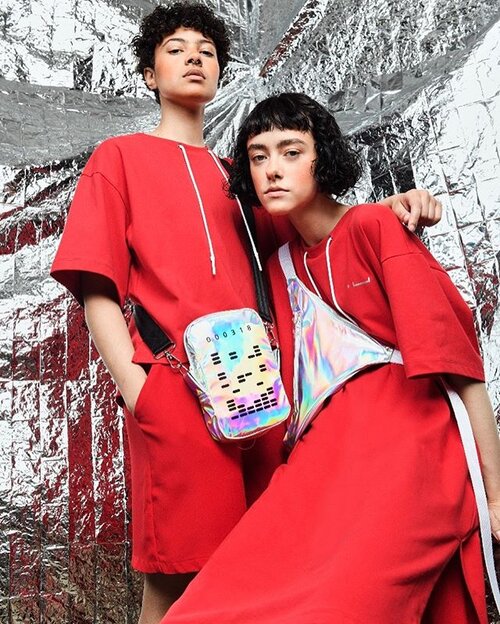
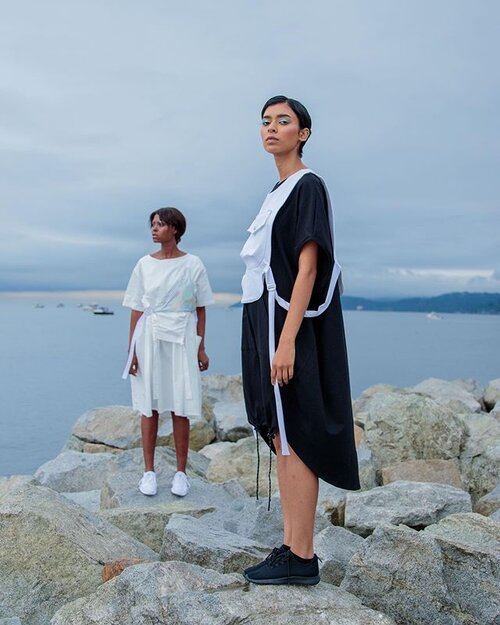
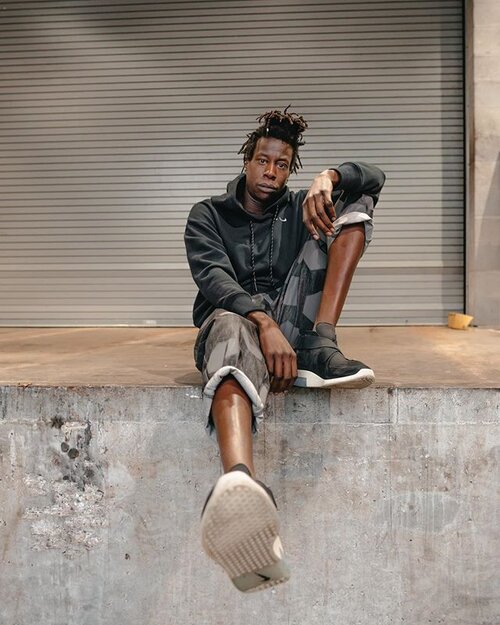
[-ization] Studio is a high-end streetwear brand. They create basic pieces in a not so basic way. Often inspired by science, the clothes can have a somewhat clinical feel and an experimental look.
Photos courtesy izationstudio.com
All of [-ization] Studio’s garments are unisex and sustainably made in Vancouver. They collect deadstock fabric from other factories to use in collections as well as locally sourcing any other fabrics and notions. They also use a lot of cotton and recycled polyester.
Limited production runs and making pieces to order mean [-ization] doesn’t have excess stock sitting around. As for samples from runways shows and photoshoots, those are gifted or sold in sample sales with the proceeds going to the charity of Herndon’s choice.
You can check [-ization] Studio out on social media or their website.
Creative director Amy Herndon is originally from Edmonton, Alberta. She became interested in fashion through the theatre and fashion programs available at her high school. She was able to learn various techniques to create costumes for theatre or anything she could imagine. While in high school, Amy participated in Skills Canada twice, coming in first at the provincial level and second nationally.
After high school, Herndon attended LaSalle College Vancouver for the Fashion Design Diploma program and graduated in 2016.
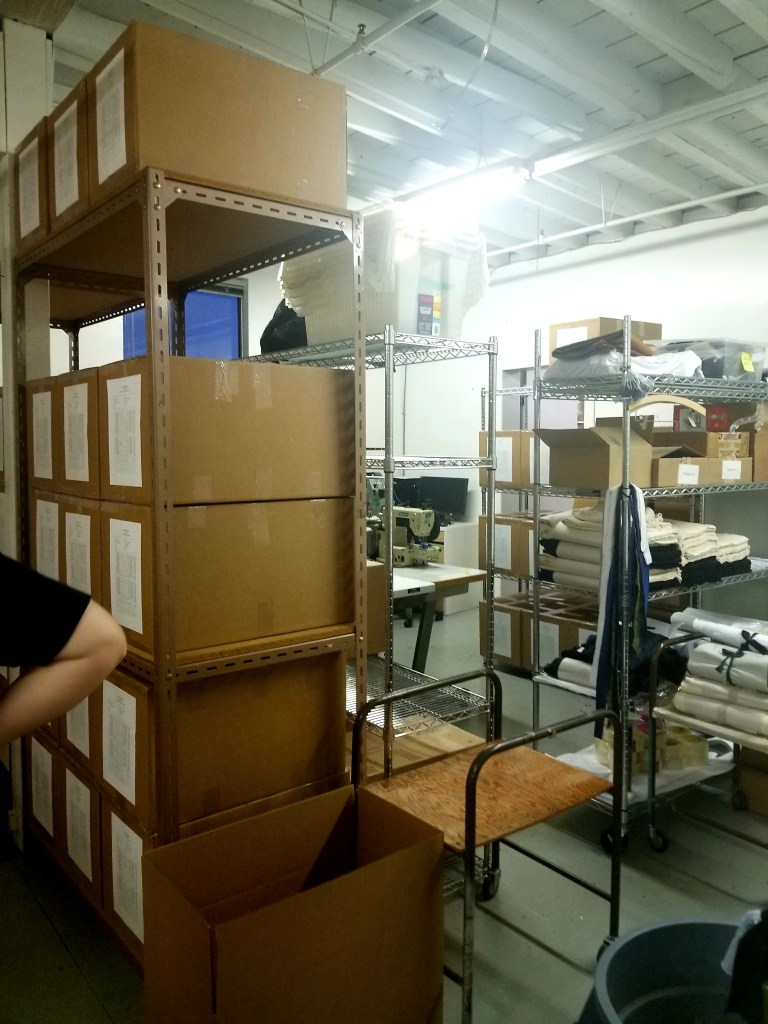
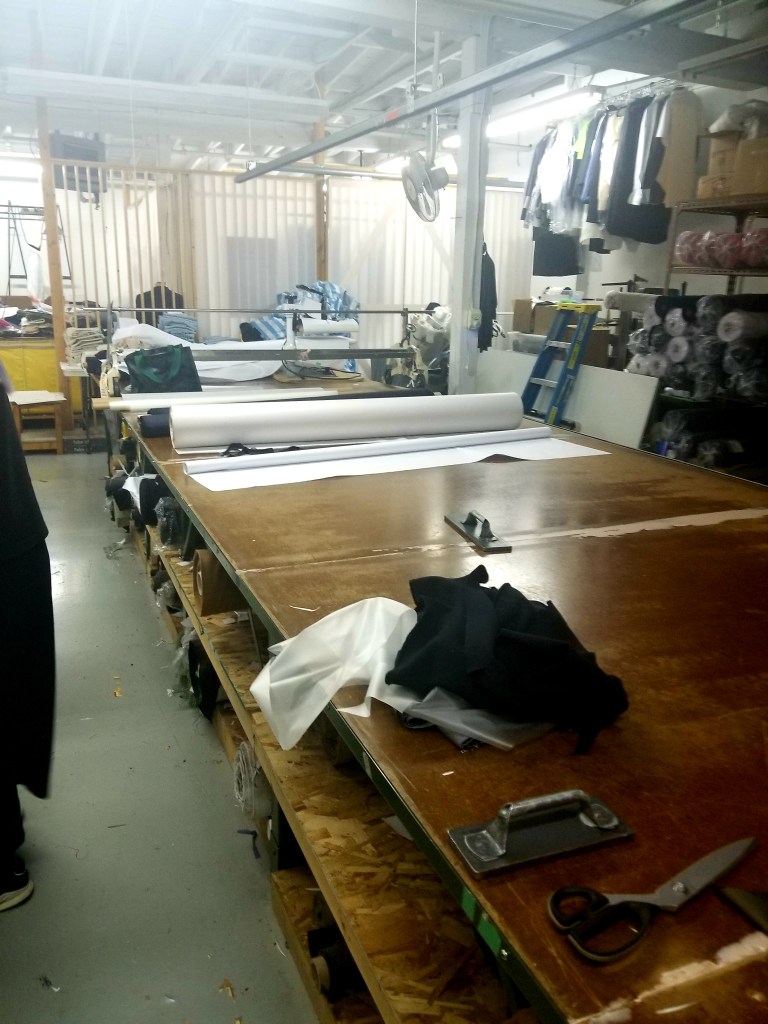
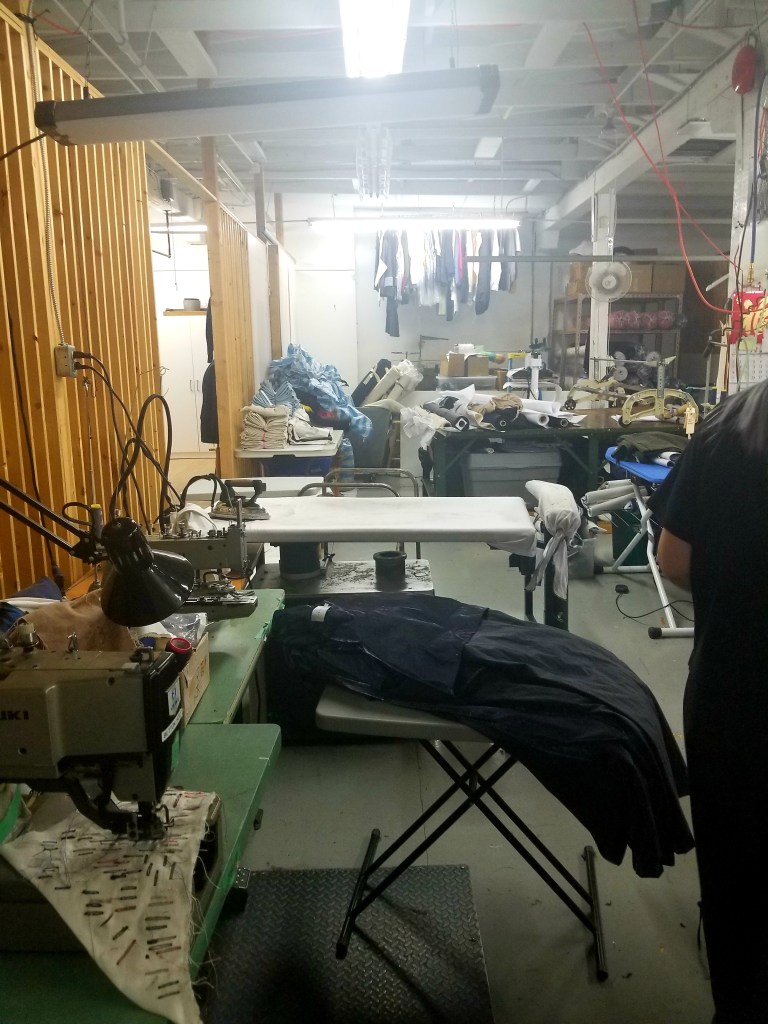
She currently works as a patternmaker for 310 Design Studio, a design and manufacturing company in Vancouver. Herndon also runs [-ization] Studio out of 310 Design Studio with her boss as her business partner. This provides a lot of control and flexibility with production. Herndon can produce things precisely how she wants and produce as few or as many pieces as needed.
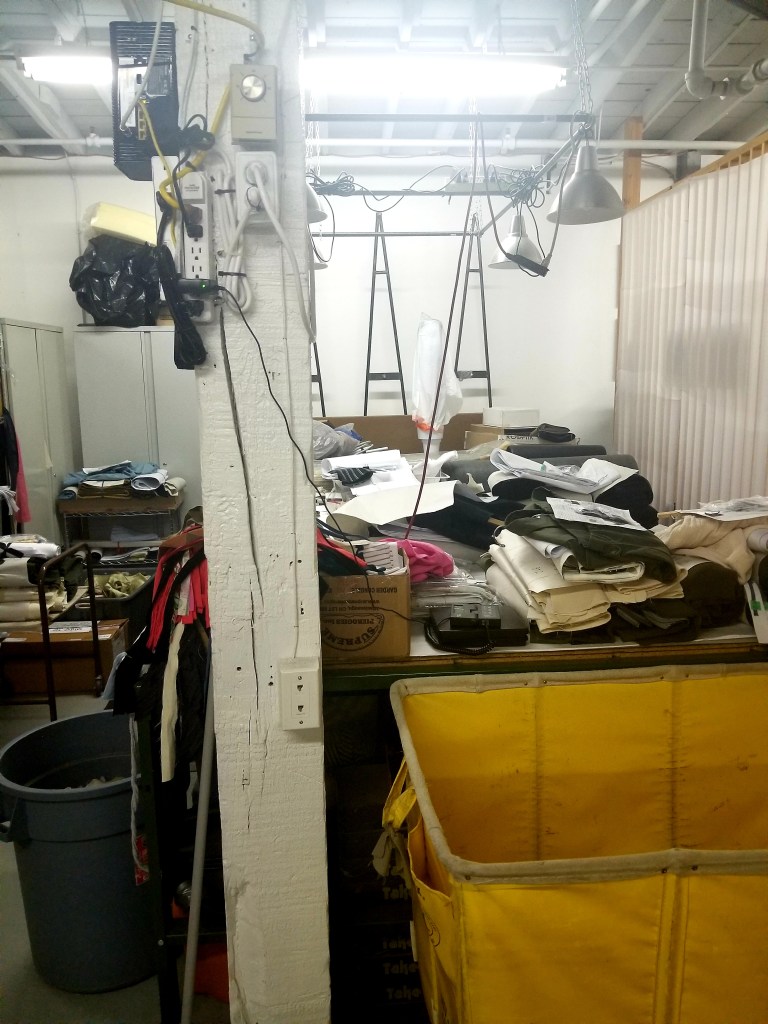
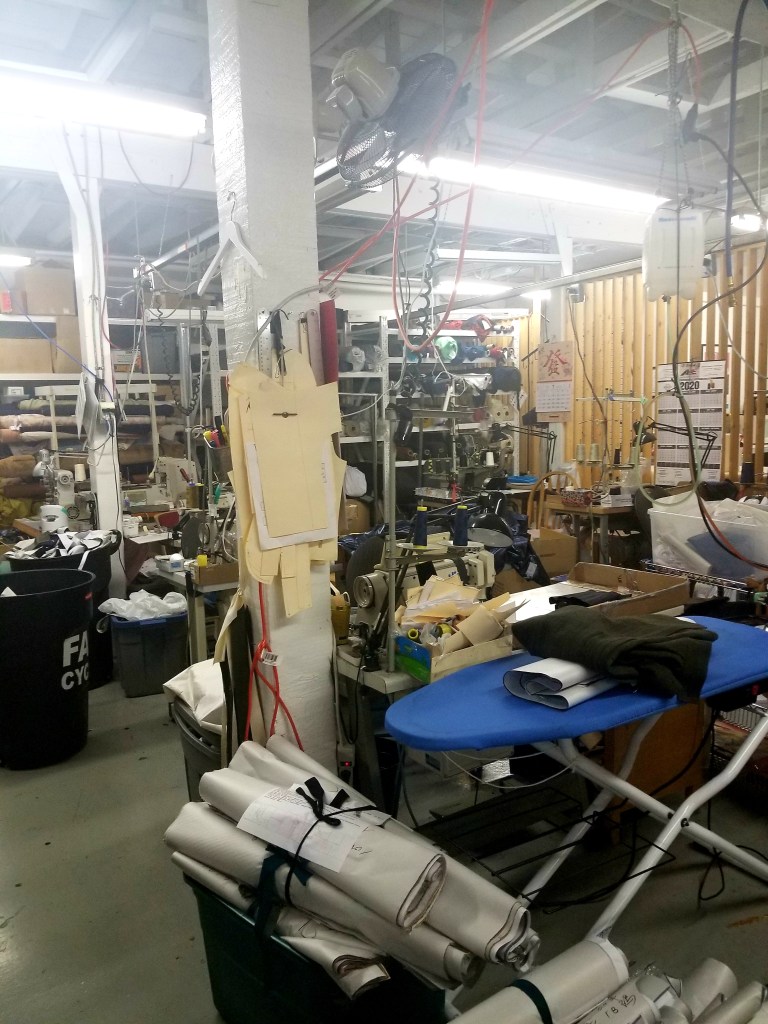
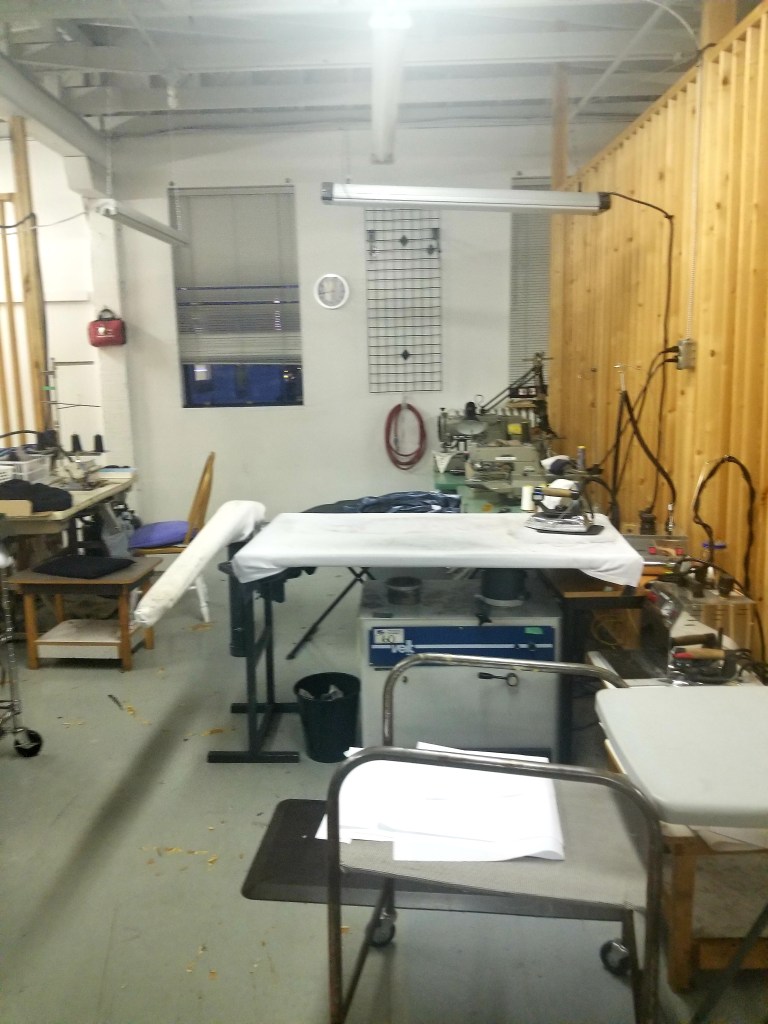
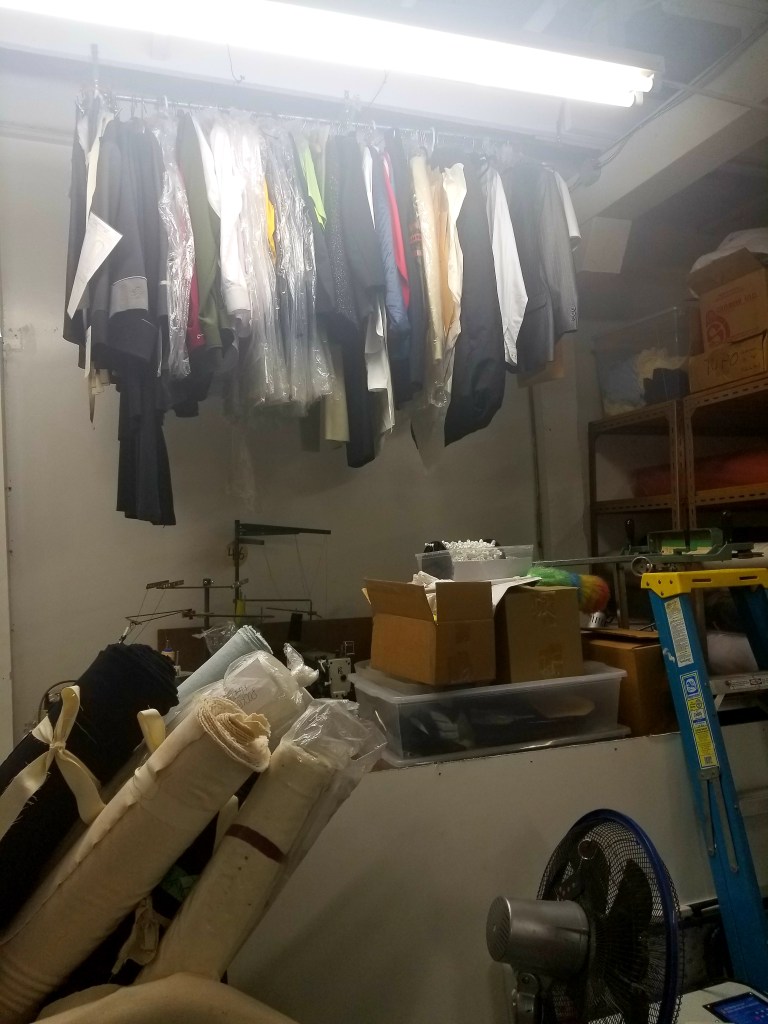
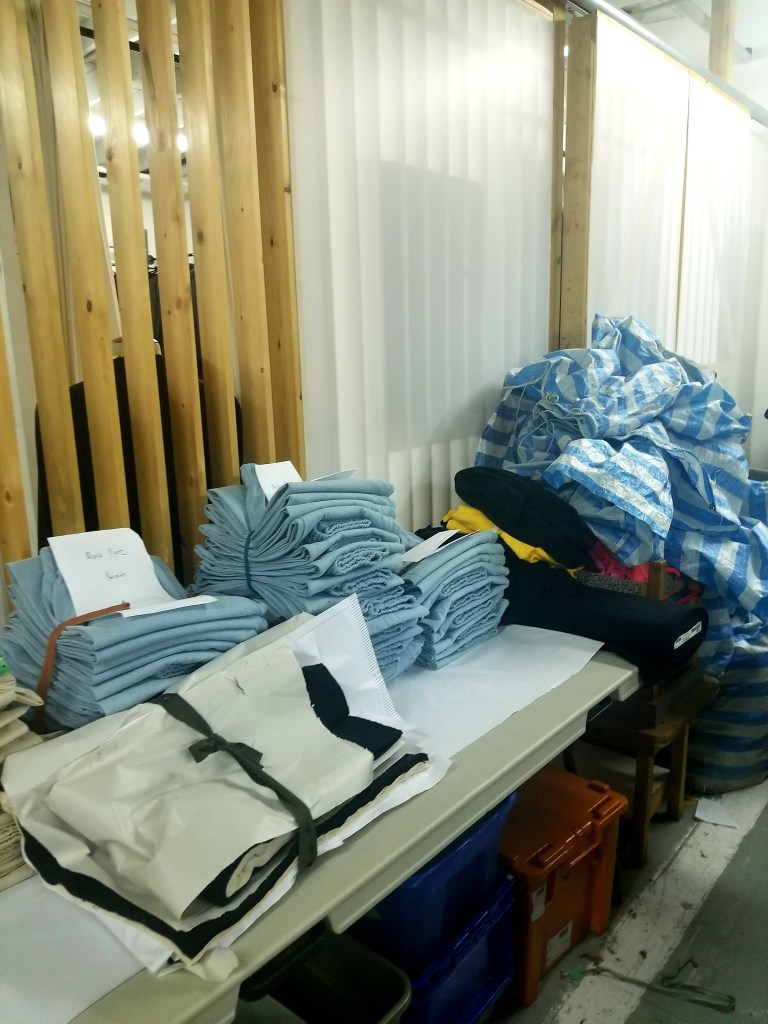
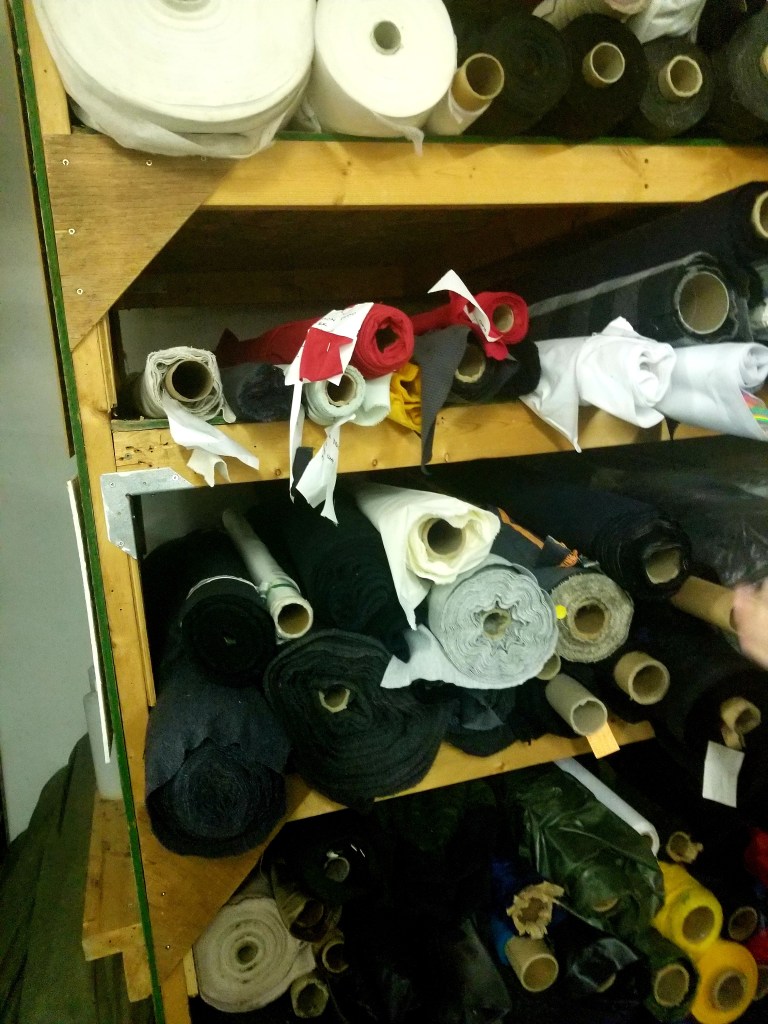
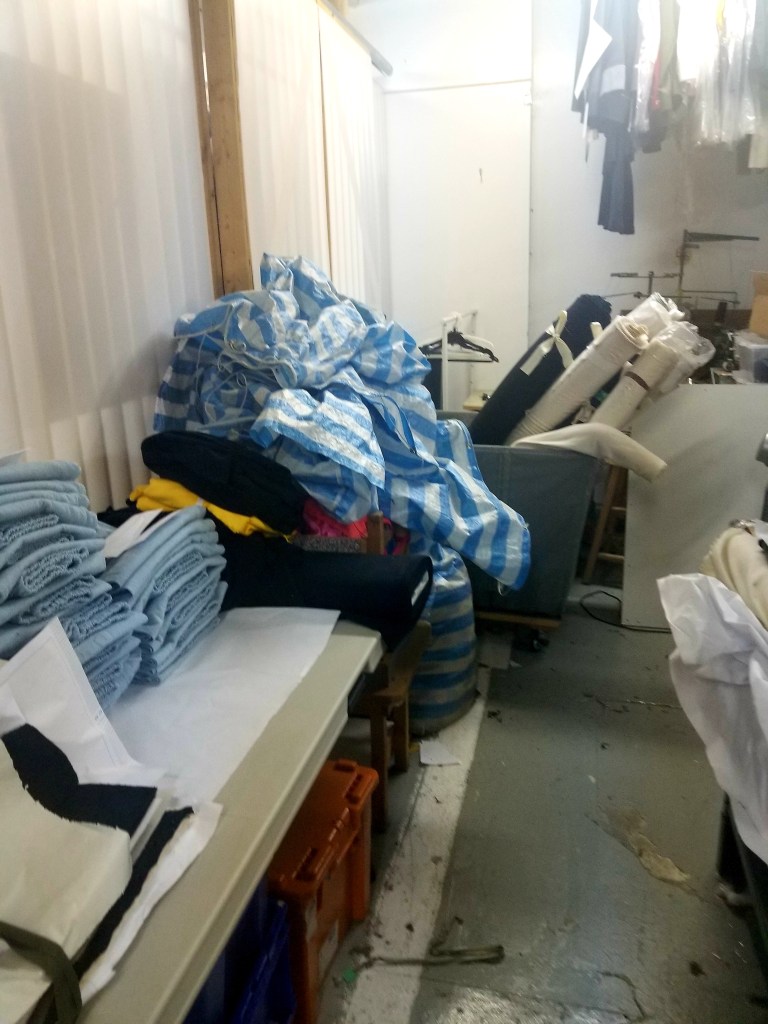
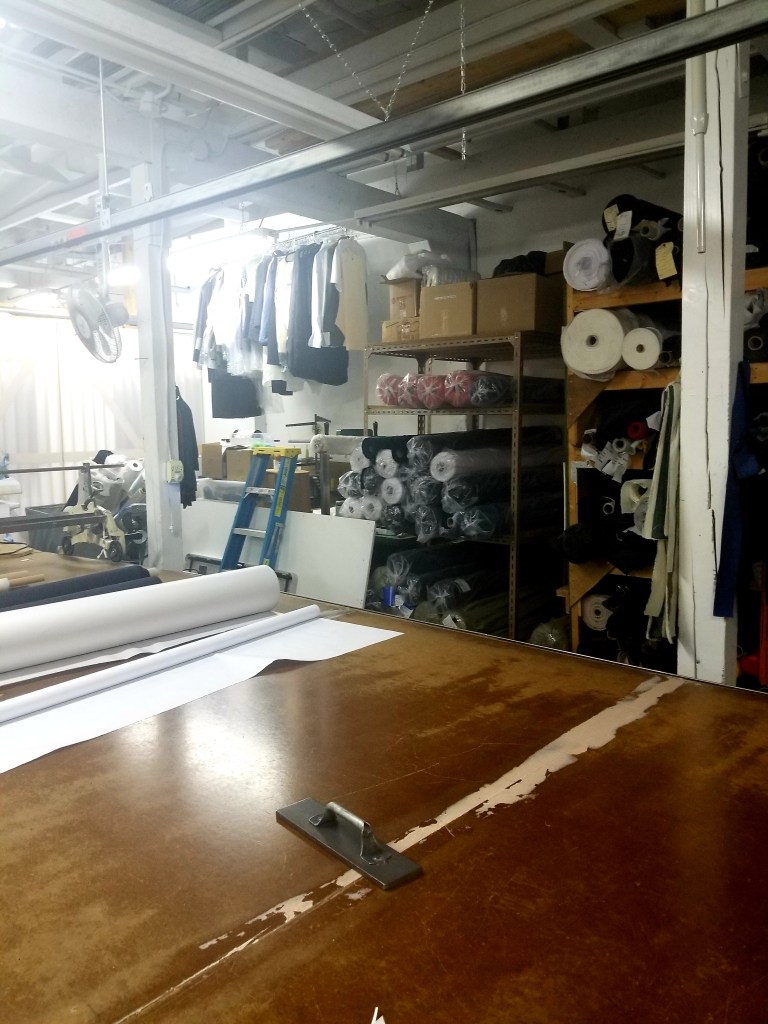
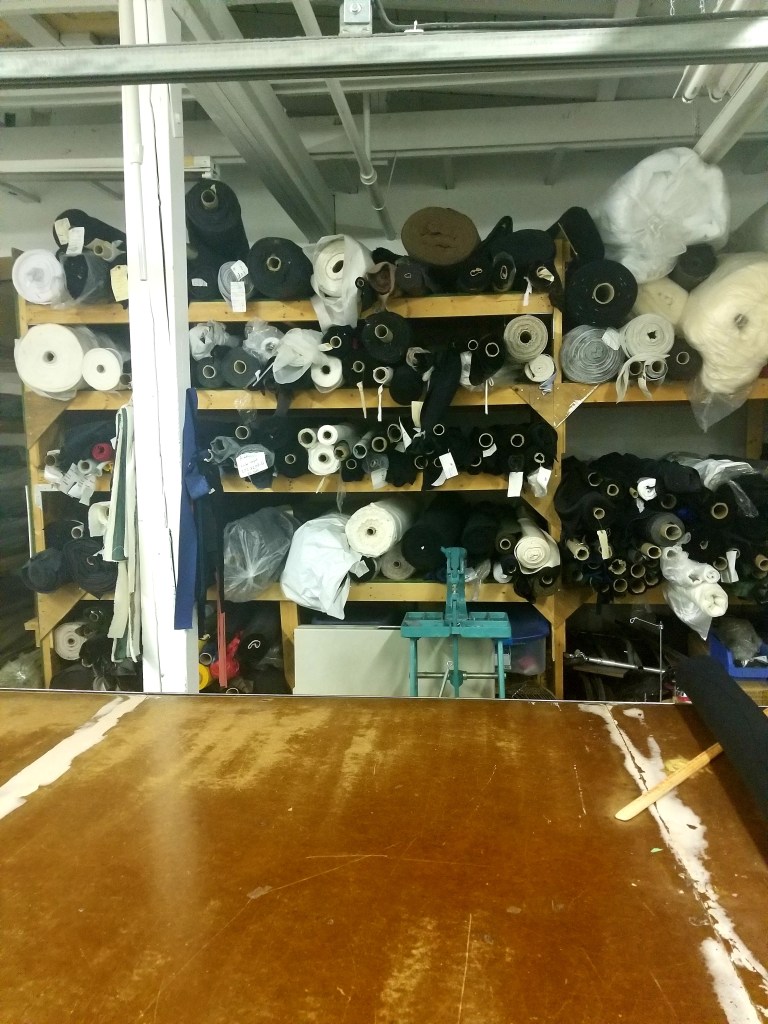
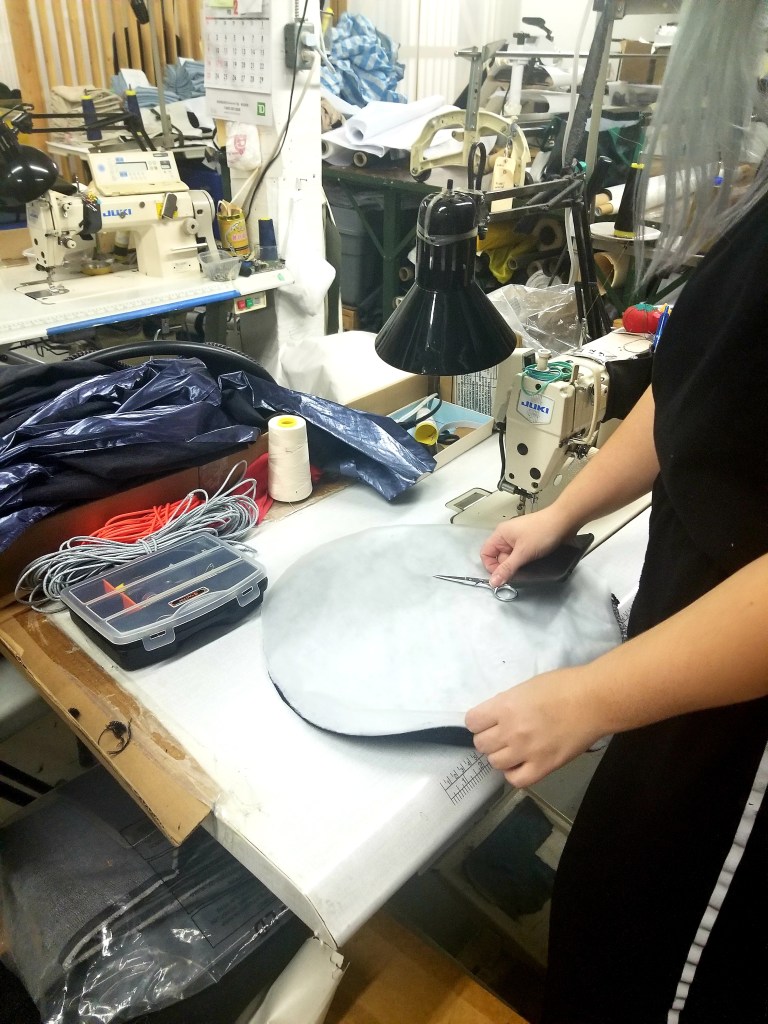
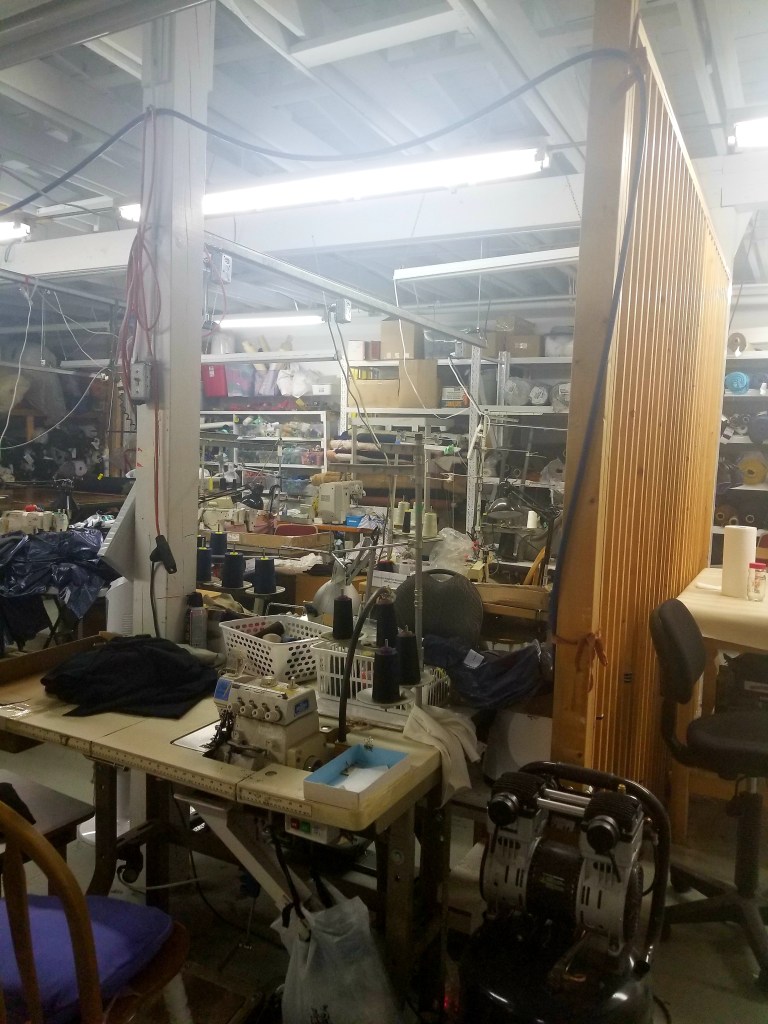
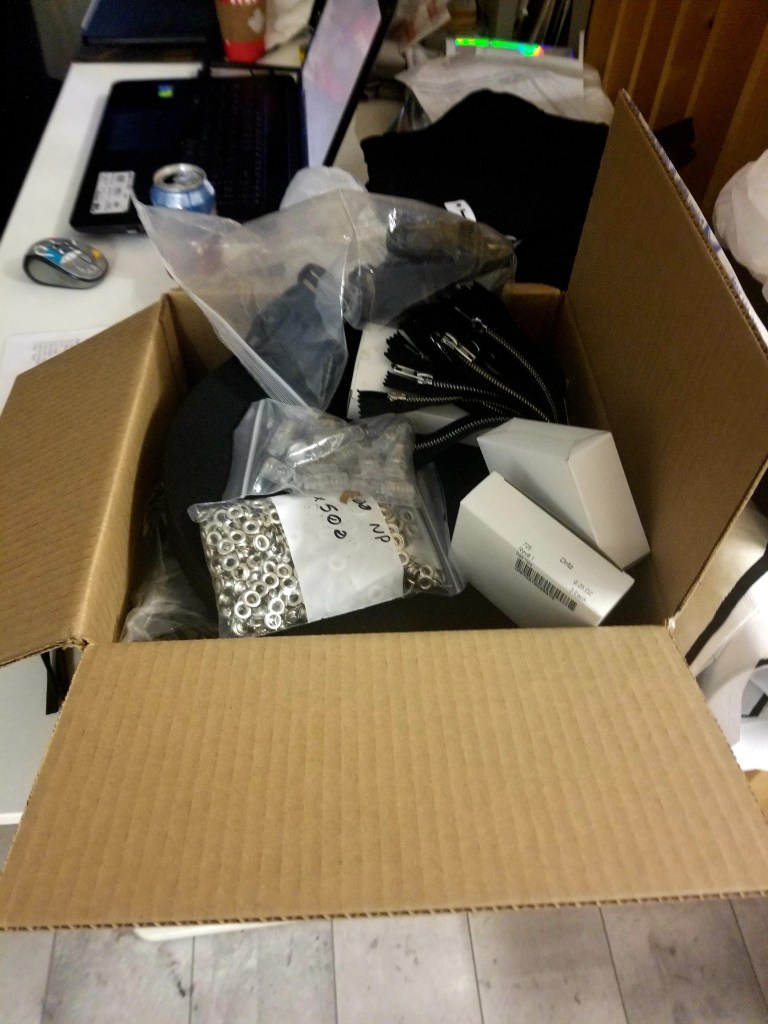
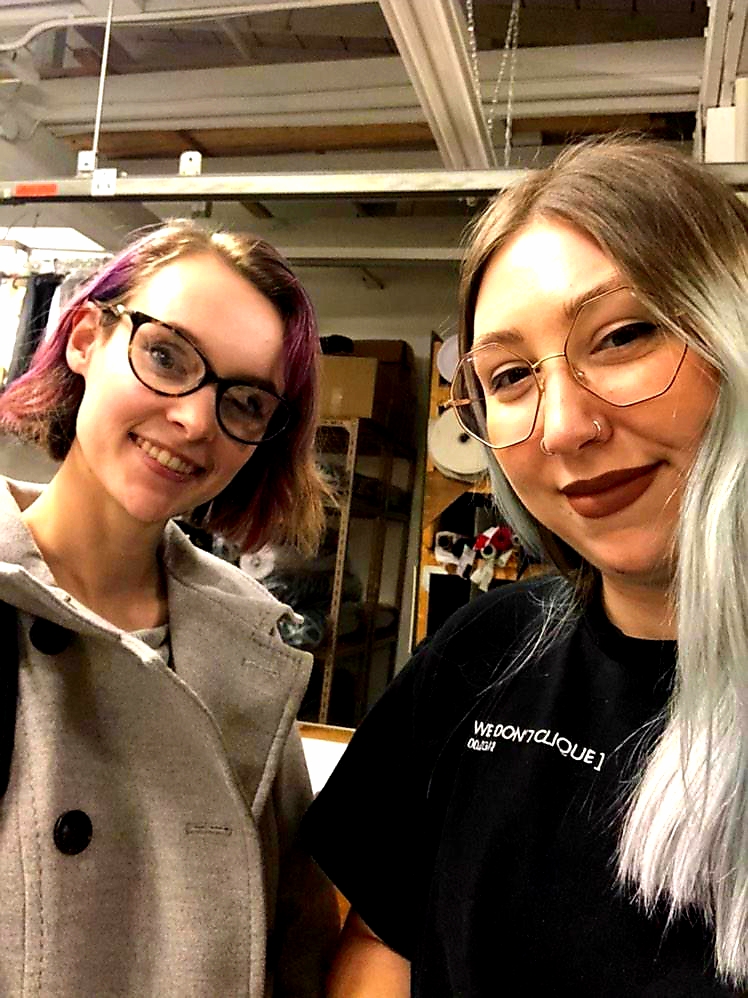
Photos taken by me while visiting 310 Design Studio.
Fun fact: Amy Herndon also likes to bake and experiment with textile dyeing.
My Shopping Bag
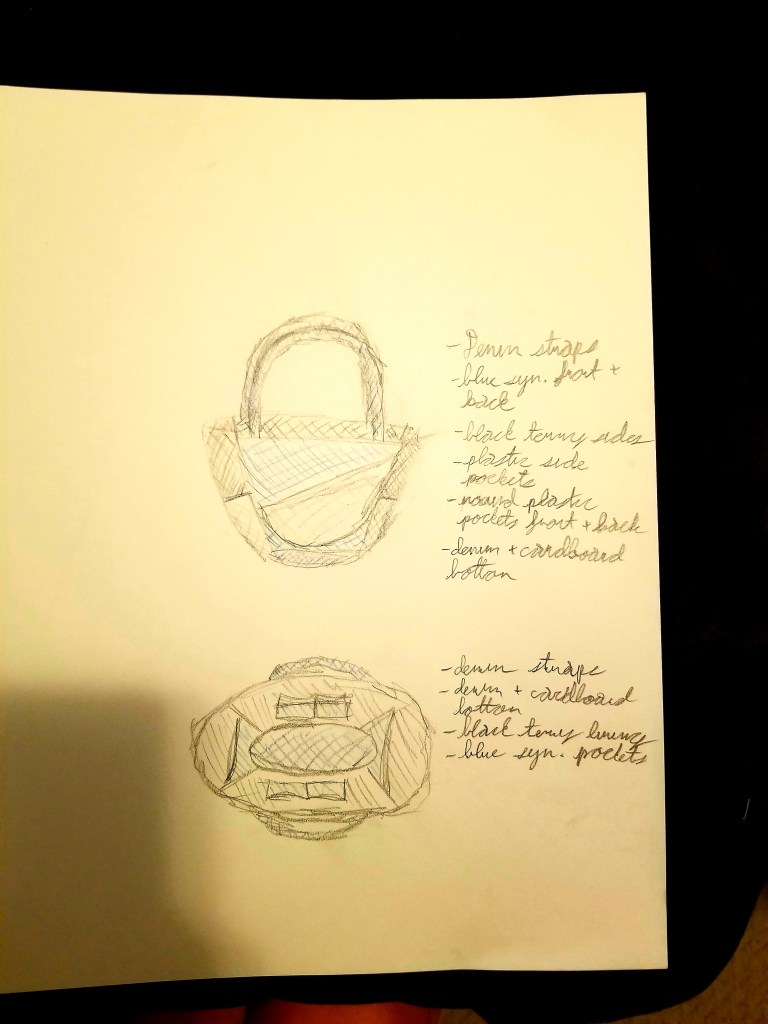
My quick sketch of the bag I planned to make.
While visiting Herndon at 310 Design Studio, I was able to collect some scraps from her to use for my shopping bag. She gave me some of [-ization] Studio’s classic french terry, as well as some denim and a blue knit from their latest collection, and some plastic that they’re experimenting with.
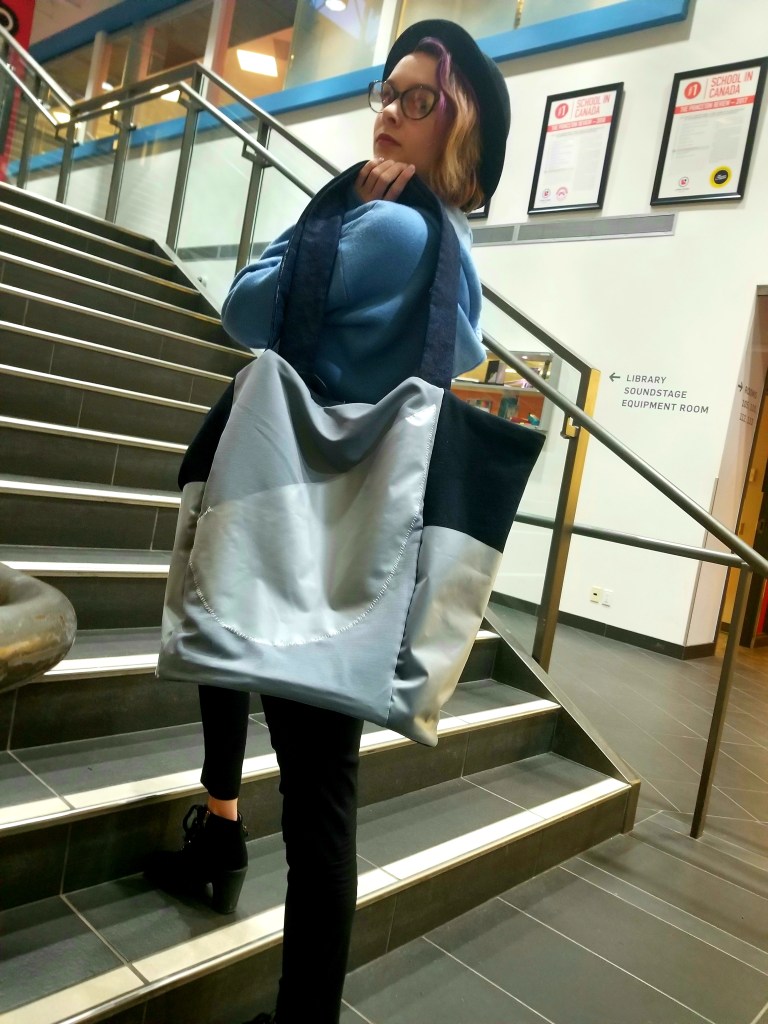
With these fabrics in hand and Herndon’s geometric designs as my inspiration, I created the following:
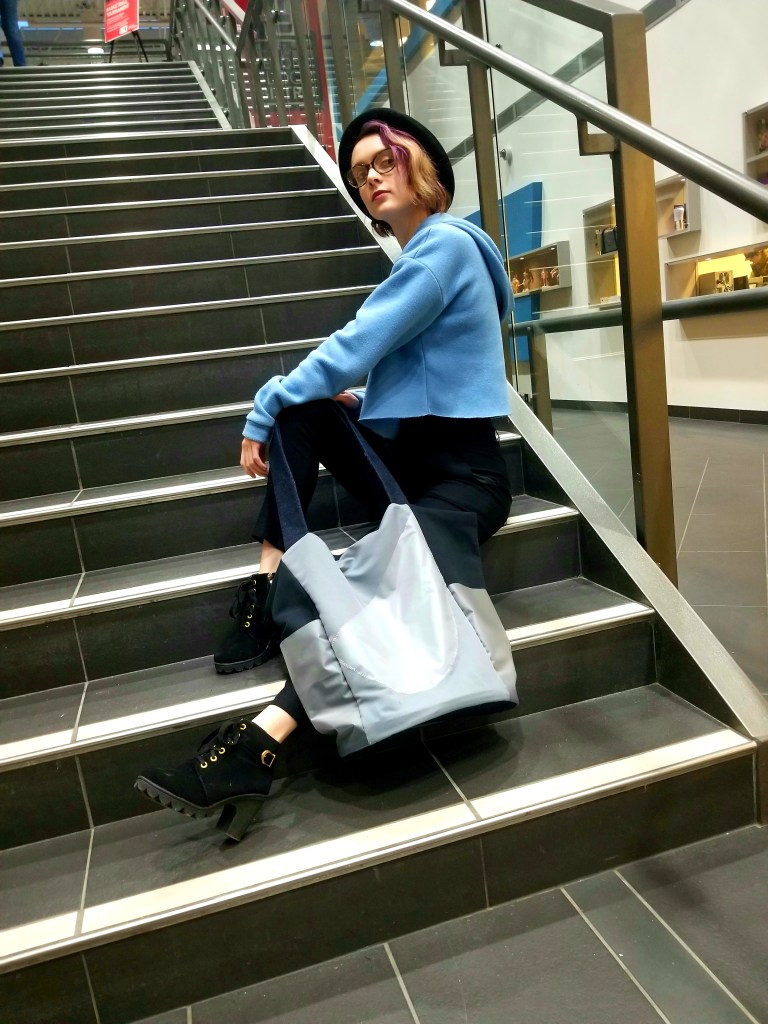
I created a fairly large bag with lots of pockets. The base is cardboard sandwiched between two layers of denim. The front and back are the blue knit with partial circle plastic pockets. The sides are French terry, also with plastic pockets. The bag is lined completely in the French terry with blue knit pockets on all four sides and I finished with two sturdy denim straps.
I was very happy with this bag, I think it’s very useful and fits pretty well with [-ization] Studio’s brand.
Don’t forget to check out [-ization] Studio and show Amy Herndon some love as a local Vancouver designer and a LaSalle College Vancouver alumni.
Welcome to the first official post from the LaSalle College Vancouver Student Fashion Blog!
We are a student-run blog looking to explore fashion across various industries and see how it impacts people everywhere and in every way, not just the textile and apparel industries. But, we’ll be covering plenty about the fashion industry as well!
Today, we’d like you to meet our two founding members!
Jaiden Shoushounova – Jaiden is a second semester student studying the Fashion Design Diploma. She wants to become a fashion designer with her own fashion line or even work for and produce a fashion magazine. “This blog will not only share my love of all things fashion with other people but for the students working on it I think it can help with their future goals and be a great addition to their resumes!” Jaiden wants this blog to grow and help shape fashion in a positive way.
Amber Rose Aiken – Amber Rose is a first semester Bachelor of Design in Fashion Design student from Bradford, Ontario. She loves creating custom designs and making people’s dream garments a reality. The blog is a way for her to indulge her curiosity and desire to learn about all things fashion. She wants the blog to help people understand the role fashion plays in daily life and beyond.
We are your two founders and reporters!
It’s just us for now but we welcome any new members with an interest in fashion, journalism, or both.
If you’re a student at LaSalle College Vancouver and think you have something to contribute, let us know!
Are you interested in fashion or more specifically fashion journalism? Take a look at the The LCV Student Fashion Blog it’s a great place to share your knowledge with fellow students and did we mention it’s run completely by students? Take a minute to read about us!
The LaSalle College Vancouver Student Fashion Blog is a club for any and everyone who is interested in fashion and journalism to come together and keep the community updated on the fashion industry and how it can impact our daily lives. Students can share the latest news about fashion, interview fellow students about their fashion choices, offer advice to help people with styling their outfits for specific events, etc. This blog will help inspire students to see their own beauty through the world of fashion and is a great opportunity to meet new people with similar interests. This club would also be a great addition to the members resumes as well.
Members can get together every 2-4 weeks in the computer labs to come up with the latest post ideas and plan out the content they would like to produce. (Blog posts can all be made ahead of time and scheduled to be posted on a weekly basis.
Here is a very short sample post to give you a good idea of the content we will be working on together!
SAMPLE POST: Staying Warm and Fashionable in the Winter
Welcome to the LCV Student Fashion Blog! This week we will be discussing how to stay warm and fashionable in the wintertime. Most people like to dress up and express their styles it’s human nature, but sometimes the weather can mess with your outfit ideas and make you wear boring clothes that do not say anything about you, fear not we have some tips that will help you out.
Fleece Tights: Do you still want to wear a skirt but the weather is just too cold? Stock up on some fleece lined tights! They come in some many colours nowadays and they keep you super warm and cozy. Quick tip! If you want to wear sheer black tights but it’s too cold out layer them over a skin toned pair of fleece tights to stay warm and keep the same effect!
2. Layers: If you have not started layering your clothing now is a great time to start! Not only does it keep you warm but layering clothing has become a styling trick used by many fashion influences and designers! You have creative freedom with your outfits so mix and match different tops to stay warm and show your style!
That was just a very short sample post to give a general idea of the content you will see here. If you have a passion for fashion join the club and expand your skills in fashion journalism we look forward to starting this new journey with you!










 LCV Student Fashion Blog